How Directional Drilling Works in Laredo Ground
Gravel caps, layered rock, and the cuts between
The Gateway's geology stacks simply and cuts dramatically: old high terraces armor the uplands with caliche-bound gravel caps — cobbly, tough on light tooling, honest once named — over the Eocene's alternating sandstones and clays, soft rock and stiff soil trading places down the column. Then the arroyos edit everything: the cuts drop through cap and layers alike, exposing the sequence in their banks and adding incision geometry to any nearby alignment. Terrain-named quoting states the cap, the layers, and the cuts per reach — because in dissected country, two hundred feet of horizontal distance can change the whole estimate.
The trade corridor and the sole-source river
Two systems organize Gateway work. The trade: the hemisphere's largest inland port runs bridges, rail crossings, inspection facilities, and logistics districts on a clock that never stops, with coordination machinery — port district, bridge operations, federal corridor interests near the line — that's well-established and daily-run. The river: Laredo's entire municipal supply comes from the Rio Grande, making source-water stewardship the standing fluid ethic and intake-corridor care its tightest form. Boundary-water machinery joins wherever alignments approach the international corridor. All of it is scope — named, documented, and priced at the desk.
The sequence, Gateway edition
The bones are standard — locates plus private designating, potholes on every claimed utility, pilot on profile, ream to about one and a half times the product, pull, restore. Gateway bends: gravel-and-layer tooling staged per reach, flash-flood discipline at every cut, supply-grade fluid care with intake-corridor tightening, port-tempo scheduling near the trade, operator checks in the energy country, heat-season work practices in a climate that means it, and restoration that treats city lawns, brush-country ROW, and corridor pavement as the different surfaces they are.
Who owns what you're crossing
The city and the downstream municipalities run their own ROW counters; Webb County's department covers a map bigger than some states' metro regions; TxDOT permits I-35, the loops, and the US spines. The city's drainage interests govern the arroyo improvements; boundary-water machinery holds the river with federal corridor coordination near the line; the port district and bridge systems run the crossings' world; railroads permit the international main lines; and the Eagle Ford's operators keep their corridors east. The quote names every owner on your alignment — here, the first questions are which cut is nearby and how close the line runs.
Straight answers
Will you hit rock on my bore?
In layers, likely — and gently: the Eocene's sandstones ream as soft rock where profiles reach them, the gravel caps argue with light tooling on the uplands, and the clays between drill quietly. None of it is basement rock; all of it rewards being named per reach — which is exactly what the quote does.
How deep do bores run under Laredo streets?
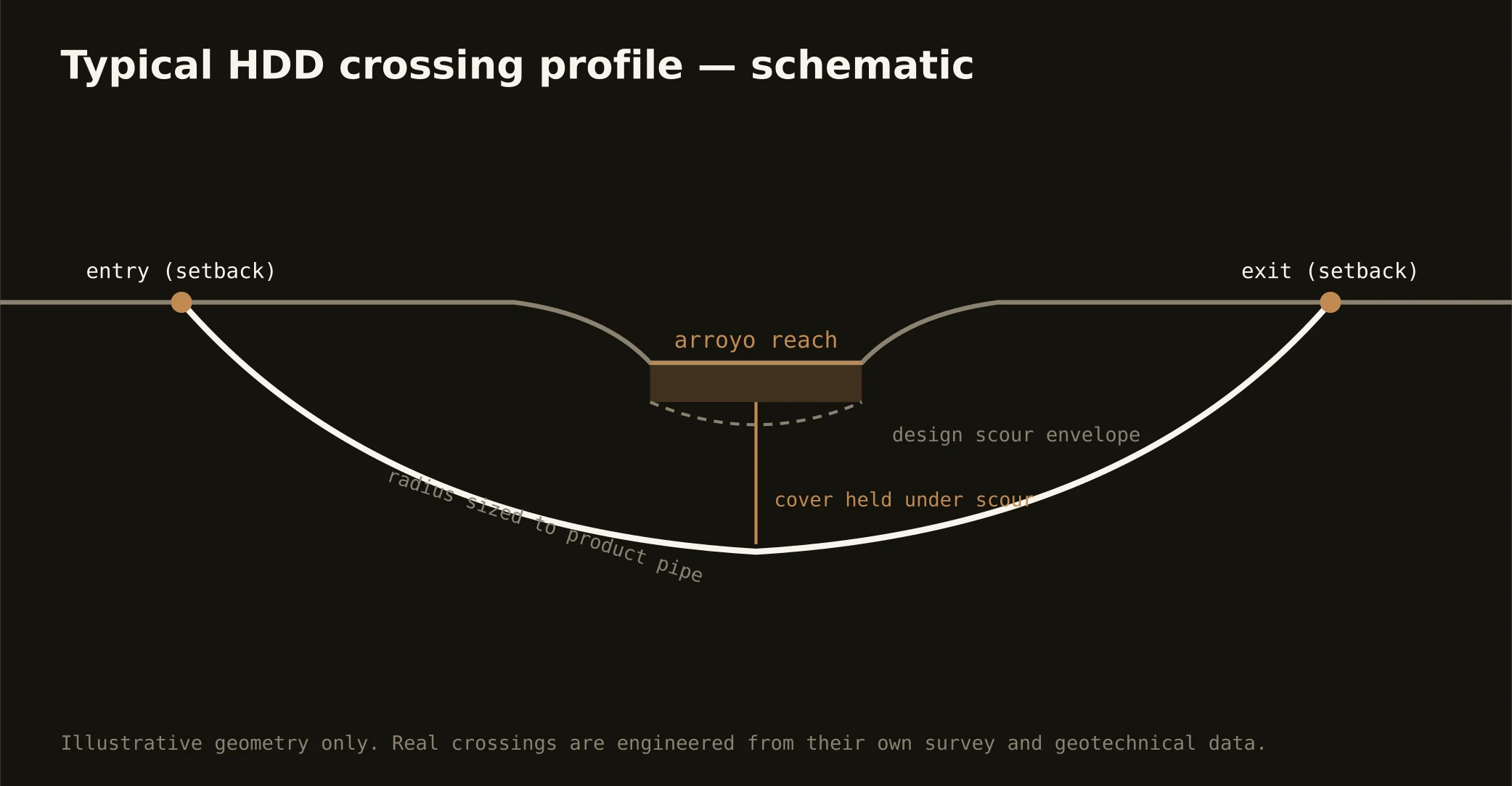
Cover follows the owning authority's standard and sits below everything potholed on the alignment — with arroyo crossings running to scour-honest depths and corridor-approach work to the coordinating authorities' criteria. The plan states your number and your terrain at it.
Does the border location complicate ordinary utility work?
Mostly it professionalizes it: away from the corridor, Gateway work runs on ordinary municipal, county, and TxDOT machinery like any Texas city's; near the river and the crossings, established coordination layers join the plan — documented, well-worn, and priced as scope. The city has run this dual register for a century and a half; our quotes speak it natively.
Ready to put a number on a real crossing? Send the scope — a person prices it.